— by Marlies Barendrecht —
We are happy to announce that our paper on drought-to-flood interactions and dynamics got published! You can read the full paper here.
Climate change is causing an increase in drought and flood events, as well as an increase in dry to wet transition. It is important to understand the processes that underly these drought-to-flood events to determine whether a flood after a drought turns out to be a benefit or a disaster.
In this collaborative paper, we present a review of the hydrological, socio-economic and adaptation processes underlying drought-to-flood interactions and dynamics. Based on an analysis of literature and a global assessment of historic cases, we show how drought can affect flood risk and assess under which circumstances drought-to-flood interactions can lead to increased or decreased risk.
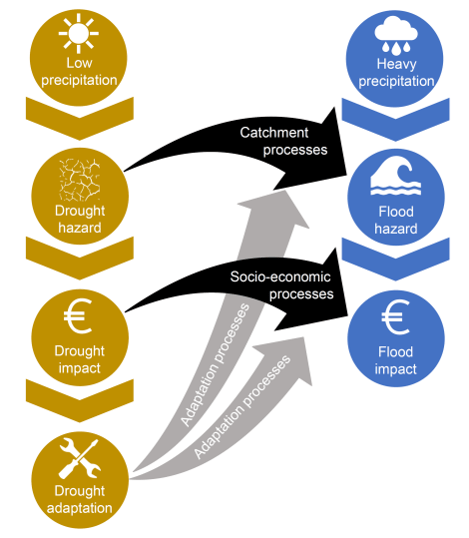
A review of the hydrological, socio-economic and adaptation processes underlying drought-to-flood interactions and dynamics. Barendrecht et al. (2023).
We find that runoff processes and storage processes can both play a role in either reducing or increasing flooding during or after a drought event. Further research is needed on when and where specific processes are dominant and especially on how this may be influenced by human interventions.
There is less evidence on the socio-economic processes that underlie drought-to-flood events, but changes in vulnerability seem to be an important factor in exacerbating impacts of drought-to-flood events compared to single drought or flood events.
We find many examples of adaptation, but there is not much evidence on when and where certain adaptation actions are taken during a drought and how this influences a subsequent flood event.
Generally, we find that there is a need for more research on the interactions and dynamics that underlie drought-to-flood events.
 PerfectSTORM